

Identifying the best LTL freight companies is essential for businesses that regularly ship partial loads too large for standard parcel services yet not big enough to fill an entire trailer. When your freight falls in that middle ground of roughly four to twelve pallets, choosing the wrong shipping method can lead to excessive handling, transit damage, and inflated costs that erode your profit margins.
We understand the frustration of managing mid-sized shipments that seem to fall between traditional shipping categories. That is why we focus on matching your specific freight profile with the most efficient transport mode, ensuring your cargo arrives safely and on schedule every time.
What Separates the Best LTL Freight Companies from Average Providers
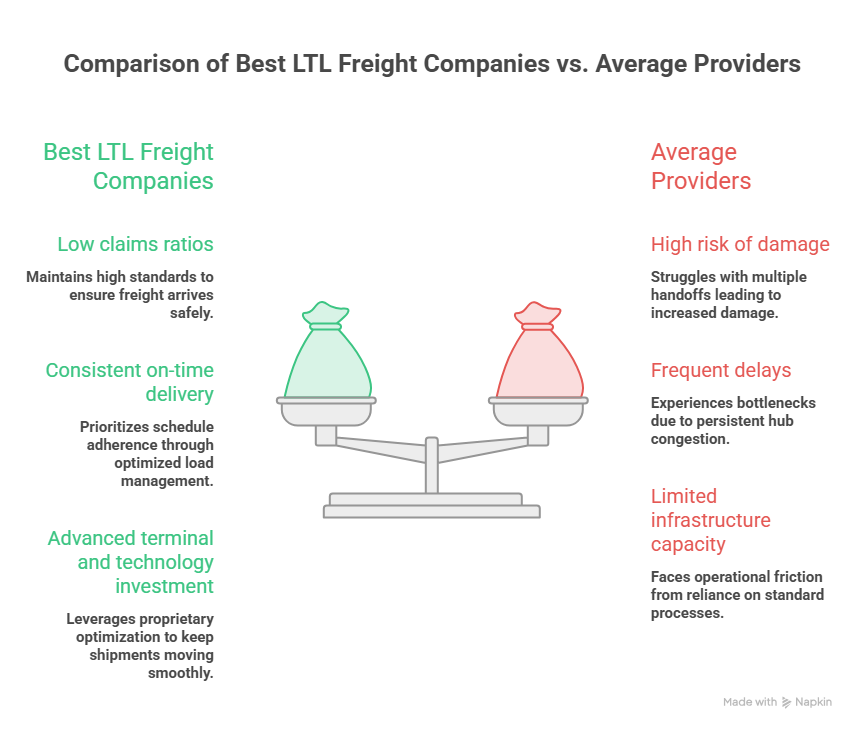
The best LTL freight companies separate themselves through low claims ratios, consistent on-time delivery, and advanced freight classification accuracy. Average providers often struggle with hub congestion and multiple cargo handoffs that increase the risk of damage and delay. Top-performing carriers invest heavily in terminal infrastructure and proprietary load optimization technology to keep partial shipments moving smoothly.
We evaluate carrier performance based on real transit data and customer feedback rather than marketing claims alone. Working with dependable LTL shipping services gives your business access to consolidated freight networks that reduce per-pallet costs while maintaining strict delivery windows. The best LTL freight companies also provide dedicated account coordinators who proactively manage exceptions before they become costly disruptions.
Difference Between LTL and Partial Truckload Shipping
The main difference between LTL and partial truckload shipping is that LTL consolidates freight from many shippers through hub networks, while partial truckload dedicates trailer space to a single mid-sized shipment. Understanding this distinction helps you avoid overpaying for freight class reclassification and unnecessary terminal handling.
When your shipment weighs between four thousand and ten thousand pounds or occupies four to twelve pallets, partial truckload often provides better value and significantly less cargo handling.
- LTL freight passes through multiple sorting terminals where pallets are loaded and unloaded several times during transit.
- Partial truckload freight is typically loaded once at origin and unloaded once at destination, dramatically reducing damage risk.
- Volume LTL rates bridge the gap for shipments that approach full truckload dimensions but do not require an entire trailer.
We help shippers analyze their freight profiles to determine whether traditional LTL or partial truckload pricing delivers the best combination of cost and cargo protection. Selecting the best LTL freight companies ensures you receive accurate freight class ratings that prevent surprise reclassification charges on your invoices.
Key Factors That Determine Reliable Partial Load Delivery
Reliable partial load delivery depends on carrier network density, terminal proximity to your shipping lanes, and precise freight classification. Shippers who overlook these factors often experience unexpected delays and inflated accessorials that blow through transportation budgets.
Evaluating potential logistics partners requires attention to several operational details.
- Terminal coverage along your most frequent shipping corridors directly impacts transit speed and reliability.
- Freight classification accuracy prevents costly reweighs and reclassification fees after pickup.
- Real-time tracking visibility allows your warehouse team to prepare receiving docks for on-time unloading.
- Carrier insurance minimums must align with the replacement value of your specific cargo.
We prioritize these operational benchmarks when coordinating partial shipments to ensure that every load moves efficiently from origin to destination without unnecessary complications.
How to Evaluate Carrier Safety Records and Compliance Standards
Evaluating carrier safety records requires reviewing active operating authority, insurance verification, and comprehensive safety measurement scores before approving any freight booking. With trucks moving 11.27 billion tons of freight in 2024 and generating approximately $906 billion in industry revenue, according to the American Trucking Associations, reliable carrier selection remains an important part of managing freight operations.
We screen every carrier in our network for active licensing, adequate cargo insurance, and clean inspection histories. The best LTL freight companies enforce strict compliance standards that help protect your freight from regulatory holds, roadside delays, and equipment issues during transit.
Strategies for Reducing Transit Damage on Mid-Sized Shipments
Reducing transit damage on mid-sized shipments requires proper palletizing techniques, protective packaging materials, and selecting carriers with minimal handling touchpoints. Freight damage claims cost the logistics industry billions annually, and partial loads are especially vulnerable when routed through congested hub networks.
We recommend several protective strategies for your partial freight:
- Stack pallets uniformly and secure them with industrial-grade stretch wrap to prevent shifting during transit.
- Use corner boards and edge protectors on fragile items to absorb compression forces inside the trailer.
- Choose direct route carriers that minimize terminal transfers and reduce overall cargo handling.
For businesses that ship dense or irregularly shaped products, exploring dedicated full truckload transport options may provide superior cargo protection when partial consolidation is not practical. The best LTL freight companies will advise you honestly on which mode best protects your specific freight profile.
Optimizing Your Freight Budget for Recurring Partial Loads
Optimizing freight budgets for recurring partial loads requires negotiating volume discounts, standardizing shipment dimensions, and consolidating weekly orders into fewer pickups. Small inefficiencies in packaging and scheduling compound quickly when your business ships multiple partial loads each month.
We work closely with shippers to identify consolidation opportunities that lower per-unit transport costs without extending delivery timelines. For industries that move heavy building supplies and raw materials regularly, coordinating construction material transportation through optimized partial networks can yield significant savings over standard spot market rates.
Partnering with the best LTL freight companies transforms your freight spend from a variable expense into a predictable and manageable operational investment.
Frequently Asked Questions
What is the difference between LTL and partial truckload?
LTL shipping combines smaller freight from multiple companies on one trailer through hub networks, while partial truckload dedicates trailer space to a single mid-sized shipment that does not require a full truck.
What are partial loads in freight shipping?
A partial load refers to a freight shipment that occupies more space than a standard LTL shipment but does not fill an entire fifty-three-foot trailer, typically ranging from four to twelve pallets.
How is LTL freight class determined?
LTL freight class is determined by evaluating the density, stowability, handling requirements, and liability risk of your cargo according to the National Motor Freight Classification system.
When should a shipper switch from LTL to partial truckload?
Shippers should consider switching to partial truckload when their shipments consistently exceed six pallets or five thousand pounds, and LTL reclassification fees begin eroding cost savings.
Building a Smarter Partial Freight Strategy
Choosing the best LTL freight companies for your partial shipments is one of the most impactful decisions your supply chain team can make this year. By focusing on carrier reliability, freight classification accuracy, and reduced handling touchpoints, your business can eliminate unnecessary damage claims and keep delivery schedules firmly on track.
When you need dependable logistics coordination and personalized freight solutions tailored to your unique shipping requirements, Freight City Logistics is ready to help your business move smarter and more efficiently across North America.