
Freight City Logistics plans heavy equipment transport in Texas for contractors, energy service companies, farm operations, rental fleets, and plant managers. Texas is big enough that the lane matters as much as the machine. A dozer leaving Houston faces different traffic, permit routing, and timing than a sprayer headed to Lubbock. We size up the load, choose the trailer, arrange TxDMV permits and escorts when they are needed, and assign a vetted, insured carrier.
As a licensed and bonded company (DOT 3752961, MC 1332997), we coordinate each move through vetted partner carriers, and the work runs through the same heavy equipment transport company process used nationwide, with one contact from quote to delivery.
Which Texas Machines Need the Most Planning
Most heavy equipment shipping in Texas falls into one of these groups:
- Earthmoving and road-building machines such as dozers, motor graders, scrapers, and excavators
- Oilfield and energy-service units, including generators, compressors, and skid-mounted equipment
- Tractors, combines, sprayers, and the attachments that go with farm equipment transport in Texas
- Cranes, forklifts, and aerial lifts for plants, warehouses, and commercial builds
- Industrial machinery moving between manufacturing sites
Texas allows 8 feet 6 inches of width, 14 feet of height, and 80,000 pounds gross weight without a permit. A semitrailer in a standard tractor combination can run up to 59 feet. Loads past those numbers need a permit before they roll.
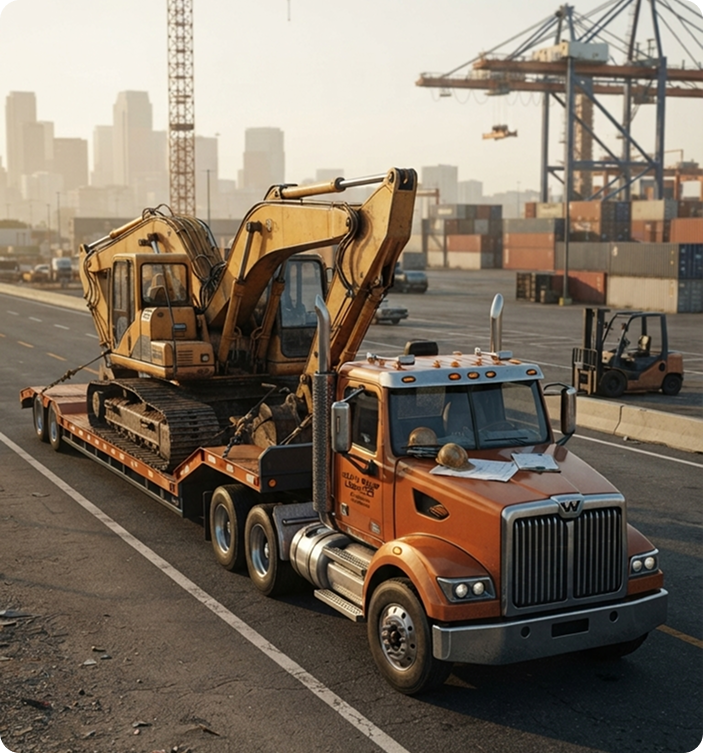
How TxDMV Oversize and Overweight Permits Work
The Texas Department of Motor Vehicles issues every oversize load permit in Texas through TxPROS, its online permitting and routing system, which accepts applications 24 hours a day. Many permit types can be self-issued, while others wait for staff review during business hours.
The carrier needs a valid USDOT number, and TxDMV checks it against federal records to confirm the company is not under an out-of-service order.
Applications also need the full load description, truck and trailer details, overall dimensions, axle spacing, and axle weights. We collect that information from you and the carrier, confirm the right TxDMV oversize permit, and make sure no heavy haul in Texas starts before approval.
Permit Types That Matter for Heavy Equipment Transport in Texas
General single-trip permit: one routed move for a non-divisible load up to 254,300 pounds
Superheavy permit: for loads above that weight, with a structural review of the route
Annual envelope permit: covers loads as wide as 12 feet, as tall as 14 feet, as long as 110 feet, and as heavy as 120,000 pounds for one year
Time permits: available for some overwidth loads, but not for widths over 13 feet
Self-propelled off-road equipment permit: lets a machine drive itself on state roads in one continuous trip
Carriers holding an annual envelope still add a single-trip oversize load permit in Texas when a machine exceeds 12 feet wide or 14 feet high.
Escorts and Travel Windows
Escort rules in Texas depend on each dimension. A load over 14 feet and up to 16 feet wide needs a front escort on two-lane roads or a rear escort on highways with four or more lanes. Past 16 feet, front and rear escorts are required everywhere. Height triggers a front escort with a height pole above 17 feet, and a second escort above 18 feet.
Long loads follow a similar pattern starting at 110 feet. Unless the TxDMV oversize permit allows night travel, oversize moves run from 30 minutes before sunrise to 30 minutes after sunset. TxDOT can also restrict routes during construction or heavy congestion.
Planning Heavy Equipment Transport in Texas by Region
Each part of Texas brings its own mix of machines, distances, and road conditions.
Gulf Coast and Houston
Port Houston and the refineries and chemical plants along the Houston Ship Channel make the Gulf Coast a steady source of industrial equipment moves. Equipment hauling in Houston, TX often involves plant gate procedures, safety orientations, and tight delivery windows that need to be shared at booking. Metro congestion matters too, since daytime-only permits leave fewer usable hours when traffic slows.
For contractors, the region’s flat terrain makes loading simple, but drainage ditches and soft shoulders at rural sites deserve a mention before the truck arrives. Tell us about site access early, and equipment hauling in Houston, TX stays on schedule more often. For the wider trucking picture in the metro, see our guide to trucking in Houston.
Dallas-Fort Worth
North Texas keeps a large share of the state’s construction equipment busy, from highway projects to warehouse pads and subdivision work. Equipment transport in Dallas, TX tends to be short-notice: a contractor finishes one phase and needs the excavator across the Metroplex the next morning.
Shorter moves inside the region can still need permits if the machine is over width or height, so dimensions matter even for a 20-mile trip. Rental fleets also reposition machines between branches here. For repeat equipment transport in Dallas, TX, sharing a project schedule lets us line up carriers in advance.
Central Texas and the I-35 Corridor
Austin, San Antonio, and the towns between them sit on I-35, one of the busiest truck corridors in the state. Large commercial builds, road work, and suburban growth keep loaders, compact track machines, and aerial lifts moving along this stretch.
Because I-35 carries so much traffic, route choice and permit timing matter more than mileage. Hill Country job sites west of the corridor can bring steep driveways and caliche roads, so photos of the site help the carrier pick the right trailer and approach.
Permian Basin and West Texas
The Permian Basin spans West Texas and southeastern New Mexico and is the largest oil-producing basin in the country, according to the U.S. Energy Information Administration. Permian Basin equipment transport usually means long rural runs from Midland, Odessa, or a supplier yard to a lease road.
Distance, daylight limits, and remote unloading points all shape the plan. Some loads continue across the state line into New Mexico, which adds a second permit. For Permian Basin equipment transport, we confirm lease access, gate contacts, and unloading help before dispatch.
Panhandle and South Plains
Lubbock, Amarillo, and the farm country around them generate a lot of tractor, combine, and sprayer traffic, especially around planting and harvest. Texas also leads the nation in wind power generation, according to the EIA, and many wind projects sit in this part of the state.
Farm equipment transport in Texas often involves wide headers and tall cabs that cross the 8 feet 6 inches width limit. Removing a header or folding a boom can sometimes keep a load legal, so ask us before assuming a permit is needed. Booking farm equipment transport in Texas ahead of peak season also leaves more room to plan.
Major Corridors and Out-of-State Lanes
Interstate routing shapes most long moves. I-10 runs from El Paso through San Antonio and Houston to Louisiana. I-20 crosses from West Texas through Midland, Odessa, and the Dallas-Fort Worth area toward Shreveport. I-35 connects Laredo, San Antonio, Austin, and DFW with Oklahoma, while I-45 links Houston with equipment transport in Dallas, TX, and points north.
In the Panhandle, I-27 joins Lubbock and Amarillo, and I-40 continues east into Oklahoma and west into New Mexico. Heavy equipment shipping in Texas that crosses a state line needs a permit from each state on the route.
Choosing a Trailer for Texas Loads
Trailer choice comes down to height, weight, and how the machine loads. A lowboy trailer in Texas is the common pick for large dozers, excavators, and motor graders, since the low deck keeps tall machines under 14 feet. A removable gooseneck works well when a machine drives on from the front.
Step decks handle mid-height loads like skid steers, compact excavators, and many farm attachments, while flatbeds suit lighter units. For a heavy haul in Texas, axle count also matters, because heavier machines may need more axles to stay within permitted weights. Share the operating weight and spec sheet, and we will match the trailer to the load and the route.
The Coordination Work Behind a Texas Lane
We review each machine’s dimensions and weight, select the trailer, map the route, and secure permits in each state the load crosses. When the rules call for escorts, our team schedules them. Before any heavy equipment transport in Texas is assigned, we verify the carrier’s operating authority, safety record, and insurance.
You get updates while the load is moving and one contact for questions. Whether the job calls for a lowboy trailer in Texas for a single dozer or equipment hauling in Houston, TX on a recurring schedule, the same process applies.
How Much Lead Time a Texas Move Needs
No single booking window fits every Texas job, so the plan works backward from your date. A machine that stays at legal size needs only a matched carrier. Once it passes 12 feet wide or 14 feet tall, a single-trip permit joins the schedule, and TxPROS can self-issue many of those at any hour. Others wait for staff review, and the permit office keeps weekday hours of 8 a.m. to 4:30 p.m. Central. Superheavy loads add a structural route review on top.
Permian Basin equipment transport can also hinge on lease access and gate contacts. Share your required date and how flexible it is, and the quote spells out realistic timing for heavy equipment transport in Texas.
Heavy Equipment and Industry Freight Services
Texas equipment shipments can serve construction projects, industrial facilities, and energy operations. These services cover several common transport needs.
Construction Equipment Transport for machinery moving between active job sites.
Specialized Equipment Hauling for oversized and overweight freight.
Check Industries We Serve to explore freight solutions for construction, energy, and industrial businesses.
Why Texas Businesses Choose Freight City Logistics
- Planning around Texas’s distinct freight regions: A move through the Gulf Coast can have different considerations from a shipment across the Dallas–Fort Worth area, Hill Country, or Permian Basin. We plan around the specific origin, destination, and route.
- Permit coordination for oversized machinery: When equipment exceeds applicable legal limits, we coordinate the relevant TxDMV permit requirements and assess whether route restrictions or escorts may affect the move.
- Transport for varied industries: We arrange equipment shipments for construction, agriculture, energy, and industrial operations, accounting for the different loading and delivery needs of each shipment.
- Long-distance route considerations: Texas shipments can cover substantial distances. We consider route suitability, load dimensions, planned stops, and delivery-site requirements when coordinating the carrier.
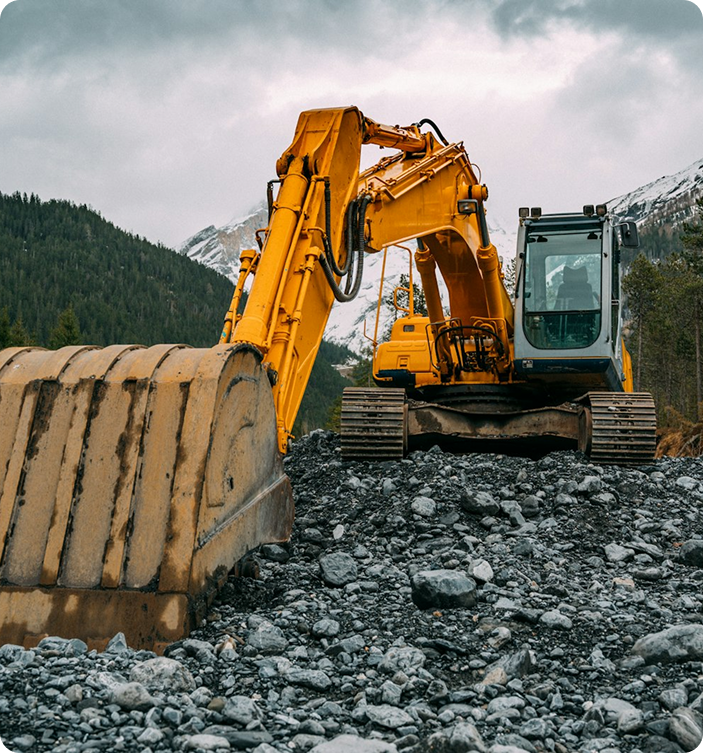
Get a Price for Heavy Equipment Transport in Texas
Call 888-520-1718 or send the Texas quote request with both ZIP codes, the machine’s length, width, height, and weight, and the model number. The team is available Monday through Friday from 7 a.m. to 7 p.m. Eastern, with on-call support for urgent freight. Permits, escorts, and trailer options are reviewed before you get a price for the heavy equipment transport in Texas your machine needs.
FAQs About Heavy Equipment Transport in Texas
How Do I Get an Oversize Permit in Texas?
Every oversize load permit in Texas comes from TxDMV through TxPROS, its online permitting and routing system, which takes applications around the clock. The carrier needs a valid USDOT number, plus the load description, truck and trailer details, dimensions, axle spacing, and axle weights. Many permits self-issue, while others wait for staff review.
How Long Does It Take to Get an Oversize Permit in Texas?
It depends on the permit. TxPROS can self-issue many single-trip permits at any hour, while others wait for staff review during weekday office hours of 8 a.m. to 4:30 p.m. Central. Superheavy loads also need a structural route review, so a TxDMV oversize permit for those should be requested as soon as dimensions are final.
How Much Does It Cost To Ship 1,000 Pounds?
The cost to ship 1,000 pounds typically ranges from $300 to $1,500+, depending heavily on the distance, the mode of transport, and the type of freight service you choose. Because 1,000 pounds is too heavy for standard parcel carriers (like UPS or FedEx Ground, which max out at 150 pounds), it must be shipped via Less-Than-Truckload (LTL) freight or air cargo.
Can You Run Oversize Loads at Night in Texas?
Only when the permit allows it. Otherwise, oversize moves run from 30 minutes before sunrise to 30 minutes after sunset, and TxDOT can add route limits during construction or heavy congestion. On a long heavy haul in Texas, those daylight hours often decide how many days the trip takes.
How Much Does it Cost to Transport Heavy Equipment?
Transporting heavy equipment typically costs between $1,000 and $5,000 for standard equipment over moderate distances, but the overall price varies based on weight, dimensions, and total mileage. Most specialized carriers calculate quotes using a per-mile rate or a flat minimum for short-haul trips.
What Is Considered a Wide Load in Texas?
Any load wider than 8 feet 6 inches is past legal width in Texas and needs a permit. An annual envelope covers widths up to 12 feet, time permits stop at 13 feet, and escorts start above 14 feet. Folding a boom or removing a header can sometimes keep heavy equipment shipping in Texas at legal width.
How Much Does It Cost to Ship a Tractor 1000 Miles?
No fixed price applies, because a 1,000-mile tractor move is priced on the machine’s width, height, and weight, the trailer, and the permits each state requires. A compact tractor on a step deck costs far less than a wide row-crop unit on a lowboy trailer in Texas with escorts. A model number and both ZIP codes settle it.