
Utah County is the county south of Salt Lake County, home to Provo, Orem, Lehi, and more than a dozen other cities, but not the whole state. Freight City Logistics arranges heavy equipment transport in Utah County, UT for contractors, developers, rental yards, farms, and industrial operators.
Each heavy equipment transport plan matches the machine to a trailer, checks UDOT permit needs, works around canyon and construction limits, and assigns a vetted, insured carrier. The company is licensed and bonded (DOT 3752961, MC 1332997) and works through partner carriers instead of a local yard, so one coordinator handles the move from quote to delivery.
From Mini Excavators to Plant Generators
Many moves for heavy equipment transport in Utah County, UT involve one of these machine types:
- Excavators, from mini units to large tracked models, which make excavator transport in Utah County the most common request type for site work
- Dozers, loaders, graders, and compactors for subdivision and road projects
- Skid steers, compact track loaders, and trenchers moving between residential lots
- Boom lifts, scissor lifts, and telehandlers for commercial and office builds
- Tractors and other farm machinery from the south end of the county
- Generators, compressors, and plant equipment for industrial sites
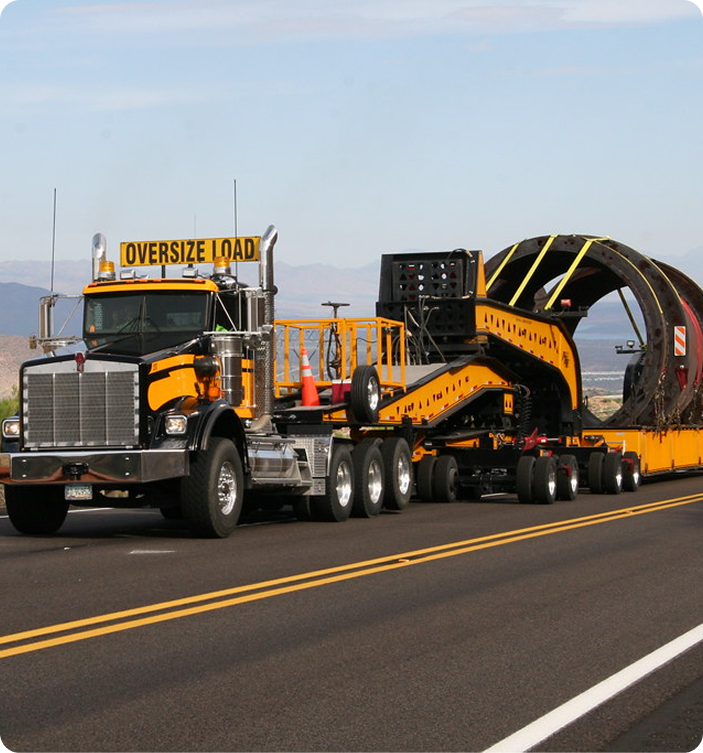
Utah’s legal limits are 8 feet 6 inches wide and 14 feet high. Most loads over 80,000 pounds also need a permit.
North, Central, and South County Hauling
I-15 runs the length of the county and carries most equipment moves, with US-89, Geneva Road, and Pioneer Crossing serving as key surface routes.
North County: Lehi to Eagle Mountain
Lehi, American Fork, Pleasant Grove, Saratoga Springs, and Eagle Mountain have grown fast, and their streets reflect it, with new subdivisions next to older farm roads. Construction equipment transport in American Fork and Lehi often means delivering to a lot with no paved access yet. UDOT’s 2100 North project, a new freeway connection between Mountain View Corridor and I-15 in Lehi, is expected to keep shifting lanes through 2028. We check current work-zone restrictions before routing a wide load through the area. Lehi-specific site and traffic details are on the Lehi equipment hauling page.
Central County: Orem, Provo, and Vineyard
Orem and Provo form the urban core, with universities, retail centers, and older neighborhoods where streets are narrower. A heavy haul in Orem, UT usually involves short distances but careful timing around traffic and school zones.
Equipment hauling in Provo, UT often serves commercial remodels, campus projects, and utility work. West of I-15, Vineyard’s growth on the former Geneva Steel land has brought steady earthwork, and the Geneva Road widening affects access to that side of the county.
South County: Springville to Santaquin
Springville, Spanish Fork, Salem, Payson, and Santaquin mix new housing, industrial parks, and farmland. Equipment transport in Spanish Fork, UT frequently connects with US-6, the main route east through Spanish Fork Canyon toward Price. UDOT’s widening of I-15 between Payson and Santaquin was still in design as of 2026, with construction expected to start as early as 2027. Farm equipment and contractor machines both use this stretch regularly.
The UDOT Rules Behind a Short Move
A machine that pushes the loaded truck past 8 feet 6 inches wide or 14 feet high needs a UDOT oversize permit, issued on a single-trip, semi-annual, or annual basis. Overweight loads also need a permit. Anything over 17 feet 6 inches high, 17 feet wide, or 300,000 pounds is processed only on weekday business hours and may take up to 14 days.
Dual-lane trailers over 10 feet wide that fail bridge validation need UDOT Structures Division clearance, which can take 14 business days or more. Whether you need heavy equipment transport in Utah County, UT, for one dozer or a heavy haul in Orem, UT, for a crane, we check these rules first.
Where the Road Work Is Through 2027
Utah County added about 15,900 residents between 2024 and 2025, reaching an estimated 765,515 people, according to the Utah Population Committee. That growth shows up as housing, schools, roads, and commercial space, and each project needs machines moved in and out. Road work adds its own constraints.
UDOT is widening US-189 through Provo Canyon to two lanes in each direction and rebuilding parts of US-6 in Spanish Fork Canyon, both expected to finish in 2027. For contractors who rely on construction equipment transport in American Fork, Lehi, or Saratoga Springs, the 2100 North project is the largest active job in the county.
Selecting a Trailer for Utah County Equipment
The best trailer depends on the machine’s dimensions, weight, loading method, and delivery location. A configuration suitable for an equipment yard may not be practical at a site with limited turning space.
| Equipment or Move | Trailer Option to Assess | Key Consideration |
|---|---|---|
| Compact equipment within legal limits | Flatbed | Loading access and securement points |
| Taller construction machinery | Step deck | Loaded height and overhead clearance |
| Heavy excavators and bulldozers | Lowboy | Weight distribution, axle requirements, and loading space |
| Self-propelled machinery requiring a low loading angle | Removable gooseneck (RGN) | Drive-on loading capability and site access |
| Unusually wide or heavy equipment | Specialized configuration, if available | Dimensions, weight, permit conditions, and route suitability |
A lowboy trailer in Provo, UT, may be appropriate for some heavy machines, but the choice must be based on the complete shipment. Trailer capacity, legal dimensions, axle weights, and route restrictions all matter.
Sites on the benches above the valley floor may have steep or unpaved approaches. Photos of the drop-off spot help us confirm whether a lowboy trailer in Provo or a shorter setup will work, especially for excavator transport in Utah County to hillside lots.
Over the Point, Up the Canyons, and South on I-15
Many moves for heavy equipment transport in Utah County start or end outside the county. Salt Lake County sits to the north across the Point of the Mountain, and I-15 connects the two. Wasatch County and Heber lie east through Provo Canyon on US-189, while Park City is reached by continuing north from Heber.
US-6 heads southeast into Carbon County, so equipment transport in Spanish Fork, UT can be the first leg of a move to Price, and US-89 branches south toward Sanpete County at Thistle. Juab County and Nephi sit to the south on I-15. Longer lanes are covered under Utah heavy equipment transport.
One Contact from Measurements to Unloading
For heavy equipment transport in Utah County, UT, the team reviews the machine’s dimensions and weight, chooses the trailer, maps a route that avoids restricted roads, and secures permits for every state involved. If escorts are required, we schedule them. Before we assign a carrier, we verify its operating authority, safety record, and insurance.
You get status updates during transit and a single contact for questions, whether the job is equipment hauling in Provo, UT, construction equipment transport in American Fork, or a long-distance move out of state. Smaller, legal-size shipments can go through Utah freight shipping.
Construction Equipment and Project Freight
Utah County projects can require machinery deliveries alongside materials for active construction sites. These services support both types of shipments.
Construction Equipment Transport for earthmoving, grading, and site-preparation equipment.
Construction Material Transportation for steel, precast components, and infrastructure supplies.
Specialized Equipment Hauling for loads needing non-standard trailers or permits.
Talk to a Coordinator About Your Utah County Job
Call 888-520-1718 or fill out the Utah County equipment quote form to start planning heavy equipment transport in Utah County, UT. Include both ZIP codes, the machine’s length, width, height, and weight, and the model number. If the site sits on a bench or in a new subdivision, a photo of the approach helps. Phones are answered Monday through Friday from 7 a.m. to 7 p.m. Eastern, with support around the clock for urgent freight.
FAQs About Heavy Equipment Transport in Utah County, UT
What Is the Going Rate for Hauling Heavy Equipment in Utah County?
The going rate for hauling heavy equipment typically ranges from $3.00 to $8.00+ per loaded mile for standard legal or lowboy shipments, and $5.00 to $15.00+ per mile for oversized, overweight, or complex loads. Hourly rates for local heavy haul services generally run between $125 and $250 per hour (often with a 2-to-4-hour minimum).
How Do You Transport an Excavator?
Most excavators are driven or winched onto a lowboy or removable gooseneck trailer with the boom tucked and the bucket lowered, then chained at the tie-down points. A lowboy trailer in Provo helps keep a large excavator under Utah’s 14-foot height limit, so the shipping height is the first number to confirm.
How Do You Move a Non-Running Excavator?
A machine that will not start cannot walk onto the deck, so the carrier typically winches it up or arranges a crane or second machine to load it. Mention the problem when booking excavator transport in Utah County, because a dead unit changes the trailer, the loading plan, and the help needed at pickup.
How Wide Can a Vehicle Be on the Road?
Utah allows 8 feet 6 inches of width, load included, before a UDOT permit is needed. Past 12 feet on secondary roads, a pilot vehicle joins the move as well. For equipment hauling in Provo, UT, wide dozer blades and track frames are the usual reasons a trip crosses that line.
Can You Haul More Than 80,000 Pounds?
Yes, with a permit. Utah issues permits for loads above legal weight, and the heaviest requests, over 300,000 pounds, are processed only during weekday business hours and may take up to 14 days. Equipment transport in Spanish Fork, UT, involving a very heavy machine should be booked with that lead time in mind.
Do you offer heavy haul in Orem, UT?
We can assess heavy equipment moves in Orem and surrounding communities. The term “heavy haul” can refer to different load sizes and requirements, so provide the equipment’s dimensions and weight along with the pickup and delivery addresses. Permit and trailer needs depend on the specific shipment.
How do I get equipment from Utah County to Salt Lake City or Park City?
Provide both addresses, the equipment’s dimensions and weight, the loading method, and your preferred dates. I-15 may be relevant for suitable routes toward Salt Lake City, while a Park City delivery may require additional review of mountain access and current road conditions. The route and delivery window depend on the shipment.
Does equipment transport within Utah County require a permit?
It may. A permit can be required when the loaded vehicle exceeds applicable size or weight limits, even for a relatively short trip. Requirements depend on the equipment configuration and route. Consult current UDOT guidance and provide the machine’s specifications when requesting a quote.
Which Utah County cities can you serve?
We can assess equipment transport requests in Provo, Orem, Spanish Fork, American Fork, Pleasant Grove, Saratoga Springs, Eagle Mountain, Springville, Payson, and other nearby communities. Service depends on the route, equipment requirements, and available qualified carrier capacity.