
Utah packs freeway valleys, high canyons, open desert, and some of the West’s biggest mines into one state, and a machine moving across it can see all of them in a day. Freight City Logistics coordinates heavy equipment transport in Utah for contractors, mines, farms, energy companies, and rental fleets. We work out the trailer, the route, and the UDOT oversize permit, then give the load to an insured carrier from our vetted network.
As a licensed and bonded broker (DOT 3752961, MC 1332997), Freight City Logistics does the planning while the carrier drives, the same split used in its heavy equipment transport services nationwide.
Machines That Keep Utah Trailers Busy
Our heavy equipment transport in Utah covers a wide range of machines:
- Excavators, from compact units to large tracked models, the most common excavator transport in Utah
- Haul trucks, loaders, drills, and shovel components that make up mining equipment transport in Utah
- Tractors, balers, swathers, and sprayers for farm equipment transport in Utah valleys
- Dozers, graders, scrapers, and compactors for highway and subdivision work
- Cranes, telehandlers, and aerial lifts for commercial and industrial projects
- Drilling rigs, pumps, and generators for oil and gas fields in the Uinta Basin
The first thing we need is the machine’s loaded height, width, length, and weight, because Utah’s permit rules key off those numbers.
When a Utah Load Needs a UDOT Permit
For heavy equipment transport in Utah, legal width is 8 feet 6 inches, and its legal height is 14 feet. A loaded truck past either number, or over legal weight, needs an oversize load permit in Utah, which is bought online through UDOT’s motor carrier system. Utah’s 14-foot height gives a little more room than states capped at 13 feet 6 inches, so some tall machines on a low trailer run legal here.
Width is the more frequent trigger. Very large loads get extra review: anything over 17 feet 6 inches high, 17 feet wide, or 300,000 pounds is processed only during weekday business hours and can take up to 14 days.
Single Trip, Semi-Annual, and Annual Options
UDOT offers permits in a few forms:
- Single trip: covers one move for a specific load and route
- Semi-annual: covers repeated moves within set limits for six months
- Annual: covers repeated moves within set limits for a full year
- Superload review: required for the largest loads, with longer lead time
Carriers that haul in Utah often hold semi-annual or annual permits, which can speed up routine work. An oversize load permit in Utah for a one-time machine is usually a single trip permit.
Bridge Validation for Very Wide Trailers
Dual-lane trailers, whose axles spread more than 10 feet wide, have to pass UDOT’s bridge validation. If a trailer fails that check, the move needs clearance from UDOT’s Structures Division, which can take 14 business days or more.
That matters for transformers, large mining components, and other heavy haul in Utah that rides on specialized trailers. We raise it at the quoting stage so the schedule allows for the review.
Pilot Escort Requirements
Utah sets pilot vehicles by width, length, and road type. One certified pilot is required for loads over 12 feet wide on secondary highways or over 14 feet wide on a freeway. Length triggers a pilot at 105 feet on secondary highways and 120 feet on a freeway, and overhangs over 20 feet need a pilot on that end.
Two pilots are required above 14 feet wide on secondary roads, above 16 feet on a freeway, or at 16 feet tall on any highway. We book them as the permit requires for each heavy haul in Utah.
Planning by Region, From Logan to St. George
Heavy equipment transport in Utah looks different in each region, with different machines and road conditions.
Wasatch Front
The string of cities from Ogden through Salt Lake City to Provo holds most of Utah’s people and most of its construction. Equipment hauling in Salt Lake City, UT, often means moving machines between rental yards, highway jobs, and new subdivisions, with I-15 traffic as the main constraint. Excavator transport in Utah is busiest here.
Utah County, south of the Point of the Mountain, is one of the fastest-growing parts of the region. Bingham Canyon Mine sits in the Oquirrh Mountains along the valley’s western edge, and its parts and machines add oversize freight to the mix. Contractors working south of the point can find local detail on Utah County equipment hauling.
Lehi and the Point of the Mountain
Lehi sits at the north end of Utah County, where I-15 squeezes between the Traverse Mountains and the Jordan River on its way out of the Salt Lake Valley. Office campuses and new housing keep compact excavators, telehandlers, and lifts making short hops on tight timelines.
Even a ten-mile move needs a permit once the loaded width passes 8 feet 6 inches. Pickup notes for the area are on the Lehi heavy equipment hauling page.
Northern Utah and Cache Valley
North of Ogden, I-15 and I-84 lead toward Idaho, and US-91 climbs into Cache Valley around Logan. Dairy, hay, and grain operations here create regular farm equipment transport in Utah’s northern counties, especially before planting and after harvest. Manufacturing plants along the I-15 corridor also move production machinery in and out.
Uinta Basin and Castle Country
East of the Wasatch Range, US-40 reaches the Uinta Basin around Vernal and Roosevelt, the center of Utah’s oil and gas activity. To the south, US-6 runs through Price and Helper in Carbon County, where coal mining and power plants have long relied on heavy machines, so mining equipment transport in Utah reaches this area too.
Moves here often cover long distances on two-lane highways, where Utah’s lower escort thresholds for secondary roads apply.
Southern Utah
I-15 runs south through Cedar City to St. George, a fast-growing area near the Arizona line. Construction keeps machines moving, and many loads continue on to Las Vegas or Arizona, which means more states’ permits on the same trip. We plan heavy equipment transport in Utah and the neighboring states as one job.
Lanes That Leave Utah
Many Utah jobs end in another state, so each permit on the route goes into the same plan.
East on I-80 Into Wyoming
From Salt Lake City, I-80 climbs Parleys Canyon, passes Park City, and drops through Echo Canyon before reaching Evanston, Wyoming. Wind and winter closures on the Wyoming side can hold a load for hours or days, which is why dates on this lane need slack. Machines bound for Rock Springs, Cheyenne, or the energy fields are covered under Wyoming heavy equipment transport.
South on I-15 Toward Las Vegas
Below St. George, I-15 cuts across the northwest corner of Arizona through the Virgin River Gorge before entering Nevada. That short stretch still means an Arizona permit for an oversize load, in addition to Utah and Nevada approvals. Construction work in Clark County keeps this lane active for heavy equipment transport in Utah, and delivery details are on the Las Vegas equipment hauling page.
Mountain Corridors and Winter Rules
I-80 climbs Parleys Canyon east of Salt Lake City on its way to Park City and Wyoming. I-70 starts at I-15 near Cove Fort and crosses central Utah into Colorado, with a long stretch through the San Rafael Swell that has few services. US-6 and US-40 cross mountain passes of their own. In winter, UDOT can activate traction rules in canyons such as Parleys.
Under a Class I restriction there, commercial vehicles over 12,000 pounds must carry traction devices on all drive tires. A heavy haul in Utah can be delayed by those rules or by closures, so winter schedules need flexibility.
Build UDOT Review Time into Your Dates
Most single trip permits for heavy equipment transport in Utah are bought online and do not set the pace of a move. A few situations do. Loads taller than 17 feet 6 inches, wider than 17 feet, or heavier than 300,000 pounds are reviewed only during weekday business hours, and that review can run up to 14 days.
A dual-lane trailer that fails bridge validation needs Structures Division clearance, which can take 14 business days or longer. Winter traction rules in the canyons add their own delays. When a job involves any of these, share your target date at the quote stage so the plan can absorb the wait.
Matching Trailers to Mines, Canyons, and Subdivisions
The trailer follows the machine, the route, and the site:
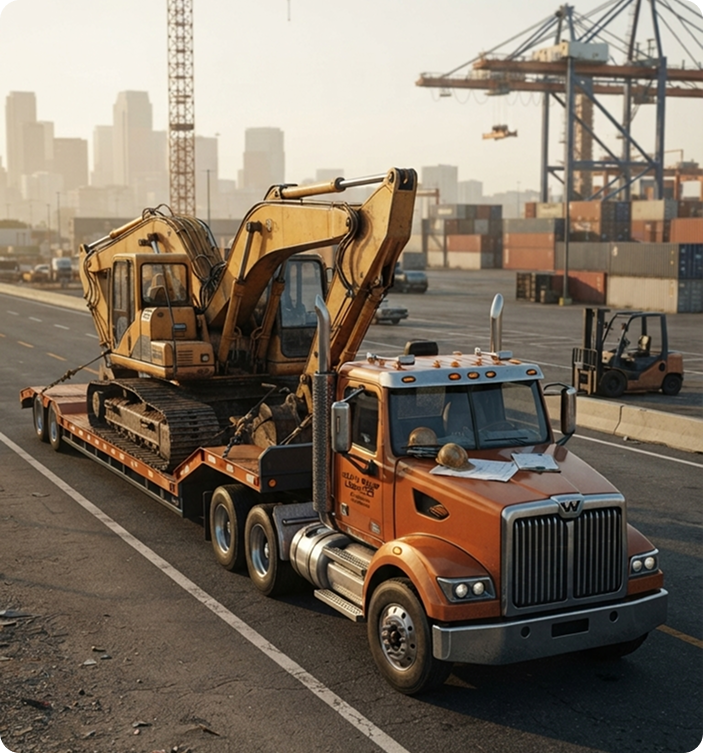
- Lowboy: the usual pick for excavator transport in Utah, keeping tall machines under 14 feet
- RGN (removable gooseneck): lets tracked equipment drive on from the front at remote sites
- Step deck: carries mid-height machines such as lifts and compact loaders
- Multi-axle and dual-lane trailers: spread the weight of mining parts and transformers, subject to bridge validation
At a mine or remote energy site, access roads and gate rules often decide the setup as much as the machine does.
Our Process for Heavy Equipment Transport in Utah
We take your machine’s measurements, choose the trailer, and build a route that fits UDOT limits, canyon conditions, and work zones. We apply for each permit the trip needs, in Utah and in any neighboring state, and book pilot vehicles where they are required.
Carriers are checked for active authority, insurance, and safety history before we assign them, and you receive updates in transit. Heavy equipment shipping in Utah is the same process whether the job is equipment hauling in Salt Lake City, UT, or a run from St. George to Idaho. Loads that fit legal limits can also move under standard Utah freight shipping.
Specialized Transport for Equipment and Energy Projects
Utah shipments may involve construction machinery, industrial equipment, or components bound for energy projects. Explore the services relevant to your load.
Construction Equipment Transport for earthmoving and site-preparation machinery.
Specialized Equipment Hauling for oversized loads requiring route planning and permits.
Explore the Industries We Serve for transportation options across construction, renewable energy, and industrial sectors.

Why Utah Businesses Choose Freight City Logistics
- Planning for mountain and canyon routes: A route through a canyon or mountain pass can present different challenges from an interstate shipment along the Wasatch Front. We consider road conditions and route suitability before arranging transport.
- UDOT permit coordination. Oversized and overweight equipment may require permits and route-specific review. We coordinate applicable requirements and account for additional planning when a load needs special clearance checks.
- Trailer choices for varied terrain and equipment. Excavators, agricultural machinery, and mining equipment can have different loading and clearance needs. We assess the shipment before selecting a suitable trailer arrangement.
- Seasonal transport considerations: Snow, chain requirements, and changing mountain-road conditions can affect equipment moves. We factor relevant seasonal restrictions into planning and discuss scheduling considerations for the intended route.
Get Your Utah Haul on the Calendar
Send the Utah heavy haul quote form with heavy equipment selected as the service, or call 888-520-1718. Include both ZIP codes, the make and model, and the loaded size and weight so the team can price heavy equipment shipping in Utah. Flag mine gate rules, canyon timing, or a hard deadline up front. Phones are answered Monday through Friday, 7 a.m. to 7 p.m. Eastern, and urgent freight has support 24/7.
FAQs About Heavy Equipment Transport in Utah
What is Heavy Haul Transportation in Utah?
A move usually counts as a heavy haul when the machine pushes the truck past legal size or weight. In Utah, that means wider than 8 feet 6 inches, taller than 14 feet, or heavier than 80,000 pounds gross. Those loads call for specialized trailers, permits, and sometimes pilot vehicles.
Which Truck Is Best for Heavy Hauling?
The trailer usually matters more than the tractor brand. A lowboy keeps tall excavators and dozers under Utah’s 14-foot height limit, a removable gooseneck lets tracked machines drive on, and a step deck suits mid-height units. The carrier then pairs that trailer with a tractor rated for the combined weight.
How Much Per Mile to Haul Equipment in Utah?
Equipment hauling in Utah typically costs $2.00 to $5.00 per mile for standard legal-size loads, and $3.75 to $12.00+ per mile for oversized, overweight, or specialized machinery.
Do I need a UDOT permit to haul oversize equipment in Utah?
Yes. You need a Utah Department of Transportation (UDOT) permit if your loaded vehicle exceeds Utah’s legal size or weight limits. The permit must generally be obtained before entering Utah, and requirements depend on the load and route.
What is bridge validation for wide equipment loads in Utah?
Bridge validation checks whether bridges along a proposed route can support the load and trailer configuration. In Utah, dual-lane trailers over 10 feet wide that fail bridge validation require clearance from UDOT’s Structures Division. This review can take at least 14 business days.
Do Utah winter conditions affect heavy equipment hauling?
Yes. Snow, ice, canyon conditions, and seasonal chain requirements can affect route selection and scheduling. We consider weather and applicable road restrictions when coordinating heavy equipment transport, particularly on mountain routes and major corridors during winter.
Can you haul mining or quarry equipment to remote Utah sites?
Yes, we can arrange transport for mining and quarry equipment headed to remote Utah sites. We assess the machine’s dimensions and weight, suitable trailer options, road access, and any permit requirements before coordinating pickup and delivery.
Which Utah routes are used for east-west equipment moves?
Interstates I-80 and I-70 are major east-west routes for heavy equipment transport across Utah. The best route depends on the origin, destination, load dimensions, weight, road conditions, and permit restrictions.
How is a Utah haul quoted?
We quote a Utah equipment haul based on the pickup and delivery locations, equipment dimensions and weight, trailer requirements, route, and any permits or escorts needed. Provide the machine’s make and model, loading details, and both addresses so we can assess the move and prepare a quote.