
Third-party logistics benefits show up when a partner lowers freight spend, widens carrier access, and frees your staff from daily carrier chasing, while you keep control of the decisions that matter. Growing shippers use 3PL support to scale capacity without buying trucks.
This guide lists eight benefits, honest trade-offs, a simple ROI view, and questions to ask before you outsource.
Key takeaways:
- Third-party logistics benefits include lower costs, wider carrier access, and scalable capacity.
- A 3PL can free staff time while improving supply chain visibility on every load.
- Measure ROI with freight savings, labor hours, claim rate, and exception cycle time.
- Under 49 CFR 371.7, a broker must not represent itself as the carrier.
- Start with the lanes that create the most exceptions, then expand when the numbers hold.
What Third Party Logistics Means
Third-party logistics (3PL) means handing transportation management to a specialist. It is a form of outsourcing logistics rather than buying trucks yourself.
Some 3PLs also run warehousing and fulfillment, while others focus only on freight. Understanding that split helps you judge which third-party logistics benefits you actually need.
A freight broker focuses on matching loads to carriers; a 3PL often wraps that work with planning, visibility, and reporting. For a deeper comparison, see freight broker vs 3PL.
For example, a manufacturer might keep its regular truckload carriers but hand overflow, flatbed, and expedited loads to a 3PL that already has those carriers vetted.
8 Third-Party Logistics Benefits
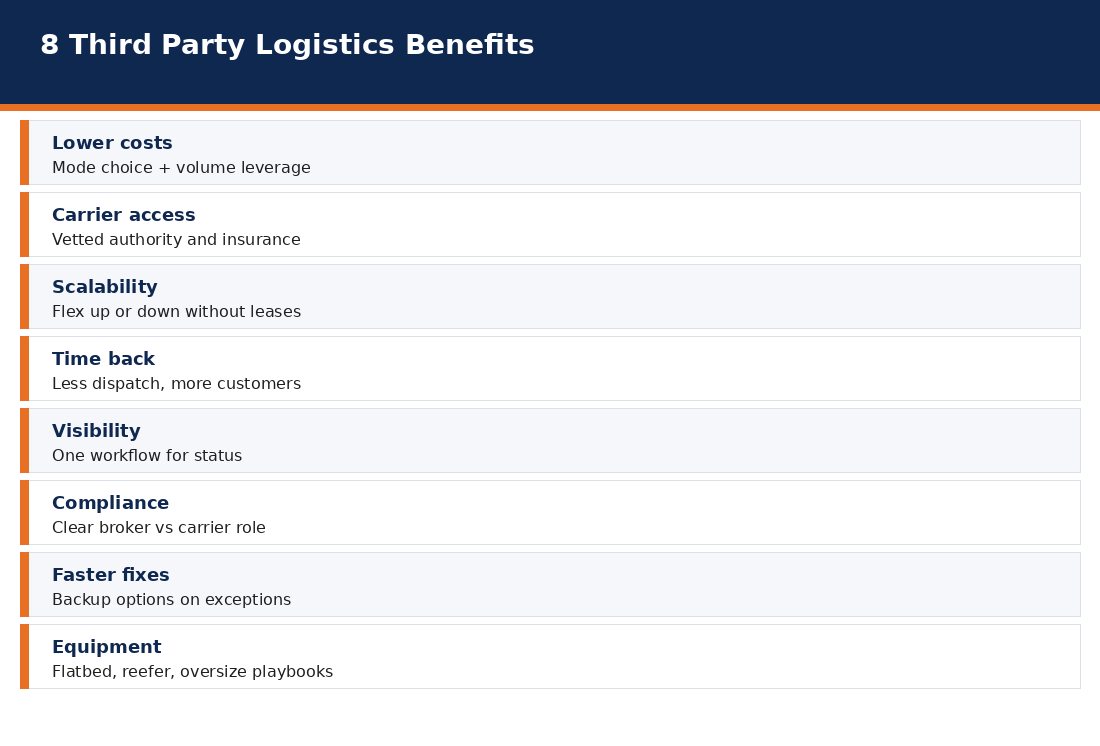
Here are eight benefits of 3PL partnerships that matter most to growing shippers, with the advantages of third-party logistics summed up in one line each:
- Lower costs: aggregated volume and better mode choices reduce spend per load.
- Carrier access: you reach carriers already vetted for authority and insurance.
- Scalability: capacity flexes with seasonal peaks without long-term truck leases.
- Time back: your team spends less time on dispatch and more on customers.
- Visibility: status updates, alerts, and invoices live in one workflow.
- Compliance support: a partner that follows brokerage rules helps you avoid costly missteps.
- Faster fixes: an experienced desk has backup options when a load goes wrong.
- Equipment expertise: flatbed, reefer, and oversize moves get the right playbook.
Lower freight and operating costs
Volume leverage and smarter mode selection create 3PL cost savings versus ad hoc booking. You also avoid hiring full-time transportation staff before your volume supports it. Savings depend on your freight profile, so ask any partner to show how it would price your actual lanes rather than quoting a generic discount.
Access to a vetted carrier network
Why use a 3PL when your own carrier list is thin? Carrier network access is a core reason. Instead of cold-calling for every overflow load, you tap carriers that your partner has already vetted for authority and insurance.
That matters most when your usual carrier is full, because a vetted backup is already in place instead of a cold call away.
Scalability for seasonal demand
Scalable shipping lets you ride peak season without owning idle trucks in January.
A 3PL can flex capacity up or down without you signing long-term truck leases, and off-peak you scale back without paying for unused capacity. When a peak fills whole trailers, our truckload services page shows how we cover full truckload (FTL) lanes.
Time to focus on core business
Dispatch emails, track-and-trace calls, and chasing proof of delivery (POD) move off your plate so sales and operations can focus on customers.
Fewer status calls also mean fewer handoff errors between your sales, warehouse, and accounting teams. That time recovery is one of the third-party logistics benefits finance teams notice first.
Technology and shipment visibility
Supply chain visibility improves when tracking, alerts, and invoices live in one workflow. You spend less time refreshing carrier portals for every load. Ask whether a partner shares tracking updates by email, portal, or both, and how quickly exceptions reach your team.
Risk and compliance support
Partners that follow brokerage rules are clear about their role, which protects you when a claim or dispute comes up.
Under 49 CFR 371.7, a broker must not represent its operations as those of a carrier. A good partner also checks each carrier’s insurance and authority before every load, not just at onboarding.
Faster problem resolution
When a truck breaks down, or a receiver delays an appointment, an experienced desk already has backup options. That speed is one of the quieter benefits on messy days. Ask how a partner escalates a missed pickup and who calls you when a delivery window slips.
Specialized equipment expertise
Flatbed, reefer, and oversize freight need different playbooks than standard dry van. Ask which equipment types a partner moves most often. To see how this work fits a provider’s wider role, read our guide on what a logistics company does.
Drawbacks and When a 3PL May Not Fit
Third-party logistics benefits come with trade-offs. Honest 3PL pros and cons include less direct control of the truck, another communication layer, and fees that only make sense above a certain volume.
If you move one truck a month on a single lane, a simple carrier relationship may be enough. A 3PL may also be a poor fit if security or regulatory needs require a dedicated in-house team.
You can reduce those risks with a written scope, a named account contact, and monthly reporting that shows cost and service results per lane.
If exceptions, multi-mode freight, or growth is already straining your staff, the partnership usually pays for itself.
How to Measure 3PL ROI (KPIs)
To measure benefits, compare what you save with what you pay: ROI = (freight savings + [hours saved × loaded labor rate] + claim reduction) − 3PL fees. Track on-time percentage, cost per hundredweight, claim rate, and average exception cycle time each quarter.
Review the same KPIs before and after you hand off lanes so the benefits of 3PL show up as numbers, not anecdotes.
How to Choose a 3PL Partner
To choose a 3PL partner, ask about industry fit, carrier vetting, technology, billing clarity, and escalation paths. Confirm whether the partner holds broker authority, carrier authority, or both, and make sure that answer matches the paperwork on every load you tender.
For a related checklist, read how to choose the right freight broker. Treat vague answers on authority, insurance, or fees as a red flag. A strong partner explains how it vets carriers, who handles claims, and how it bills accessorials before you tender the first load.
Talk to Our Team
We start with a short review of your current carriers, lanes, and pain points, then show where outsourcing would change cost or workload.
You decide which lanes to test first, and nothing changes until you approve the plan. That paced rollout is how shippers prove third-party logistics benefits before they move their entire book of business.
We are licensed and bonded (DOT 3752961, MC 1332997) and coordinate freight through our partner carrier network. Reach us through our contact us form, and attach a typical week of shipments if you can.
Frequently Asked Questions
What are the main benefits of a 3PL?
The main benefits are lower total logistics cost, access to more vetted carriers, scalable capacity, and better shipment visibility. A 3PL also gives your core team time back, so staff can focus on customers instead of chasing trucks and paperwork every day.
Is a 3PL worth it for small businesses?
A 3PL is often worth it when shipping already consumes staff time or when you need capacity beyond a few familiar carriers. Very low volume on one stable lane may not need a full 3PL, so compare the fees with the hours you would save.
How does a 3PL save money?
A 3PL saves money through better mode selection, consolidated purchasing power, fewer expedited shipments, and less internal labor on booking and tracking. Savings vary by freight profile, so measure spend per load, labor hours, and claim costs before and after you switch.
What are the disadvantages of 3PL?
The main disadvantages of a 3PL are less direct control over the truck, added communication layers, and fees that only pencil out above a certain volume. Clear service-level agreements (SLAs), named contacts, and regular reporting reduce those risks for most growing shippers.
What should I look for in a 3PL provider?
Look for verified authority, transparent pricing, industry experience, responsive exception handling, and technology that gives you usable visibility. Ask for references on lanes like yours, and confirm who your day-to-day contact will be before you sign, because third-party logistics benefits depend on the right fit.
Outsource the Chaos, Keep the Control
The right 3PL partnership should feel like adding a trained desk, not losing visibility. When you want a licensed, bonded team to show where third-party logistics benefits apply on your lanes, contact Freight City Logistics.
Start with the lanes that cause the most exceptions, measure the results for a quarter, and expand only when the numbers hold. That approach keeps the decision grounded in data rather than promises.