
Freight broker vs 3pl is one of the first sourcing questions growing shippers ask, and the models are not interchangeable. This guide defines each role, compares scope and contracts, and helps you pick the partner that fits the freight you actually move.
Key takeaways:
- A freight broker arranges transportation between shippers and motor carriers for specific loads or lanes.
- A 3PL often packages warehousing, fulfillment, technology, and transportation under one outsourced program.
- U.S. property brokers need FMCSA broker authority and a surety bond or trust fund under 49 CFR 387.307.
- Choose a broker for project and spot capacity; choose a 3PL when you need an integrated logistics stack.
- We are a licensed and bonded freight broker (DOT 3752961, MC 1332997) and arrange capacity through a partner carrier network.
Freight Broker vs 3PL: The Short Answer
A freight broker matches a shipper that needs a truck with a carrier that has one. A 3PL usually sells a broader outsourced logistics package that can include storage, order fulfillment, technology, and transportation.
That is the core difference between a freight broker and a 3PL in one line each: brokers arrange moves; many 3PLs run ongoing logistics programs. The choice then becomes a scope decision, not a slogan contest.
Brokers are a form of non-asset-based logistics: they typically do not own the warehouses or the trucks that haul your freight. Some 3PLs are also non-asset, while others run warehouses, fleets, or both. Keeping those definitions straight prevents a messy freight broker vs. 3PL RFP later.
What Is a Freight Broker
A freight broker connects shippers with motor carriers, negotiates rates, and coordinates pickup and delivery details for the booked load. The broker does not take possession of the freight the way a carrier does when it loads a trailer.
In the United States, property brokers need FMCSA broker authority. Under 49 CFR 387.307, brokers must maintain a $75,000 surety bond (BMC-84) or trust fund (BMC-85) as financial responsibility.
Freight brokerage is transaction-oriented. You may book one project move or a recurring lane, see a rate confirmation for each shipment, and keep control of how inventory and warehouses work on your side.
For a deeper selection checklist after you decide a broker fits, use a structured vetting list that covers authority, insurance, and communication before you compare rates.
What Is a 3PL
A third-party logistics (3PL) provider sells outsourced logistics services that often go beyond a single truckload booking. Common pieces include warehousing, pick-and-pack, returns, visibility tools, and transportation management.
Longer service agreements are the usual frame: multi-month or multi-year terms, service-level targets, and shared operating processes. An asset-based carrier that also offers warehouse space may market itself as a 3PL, while a non-asset 3PL may orchestrate partners instead of owning buildings.
Further, the guide discussing what a logistics company does walks through the broader role many buyers expect when they hear “logistics partner.” Use that context when you map 3PL proposals against a pure brokerage quote.
A 3PL can still hire brokers or carriers underneath. Ask which legal entity appears on the bill of lading and who holds cargo insurance for the highway move. That paperwork check belongs in every freight broker vs 3pl evaluation.
Comparison Table (scope, contract, cost model, control, technology)
Use this side-by-side when you frame freight broker vs third-party logistics for a procurement review. Columns follow the plan: scope, contract, cost model, control, and technology.
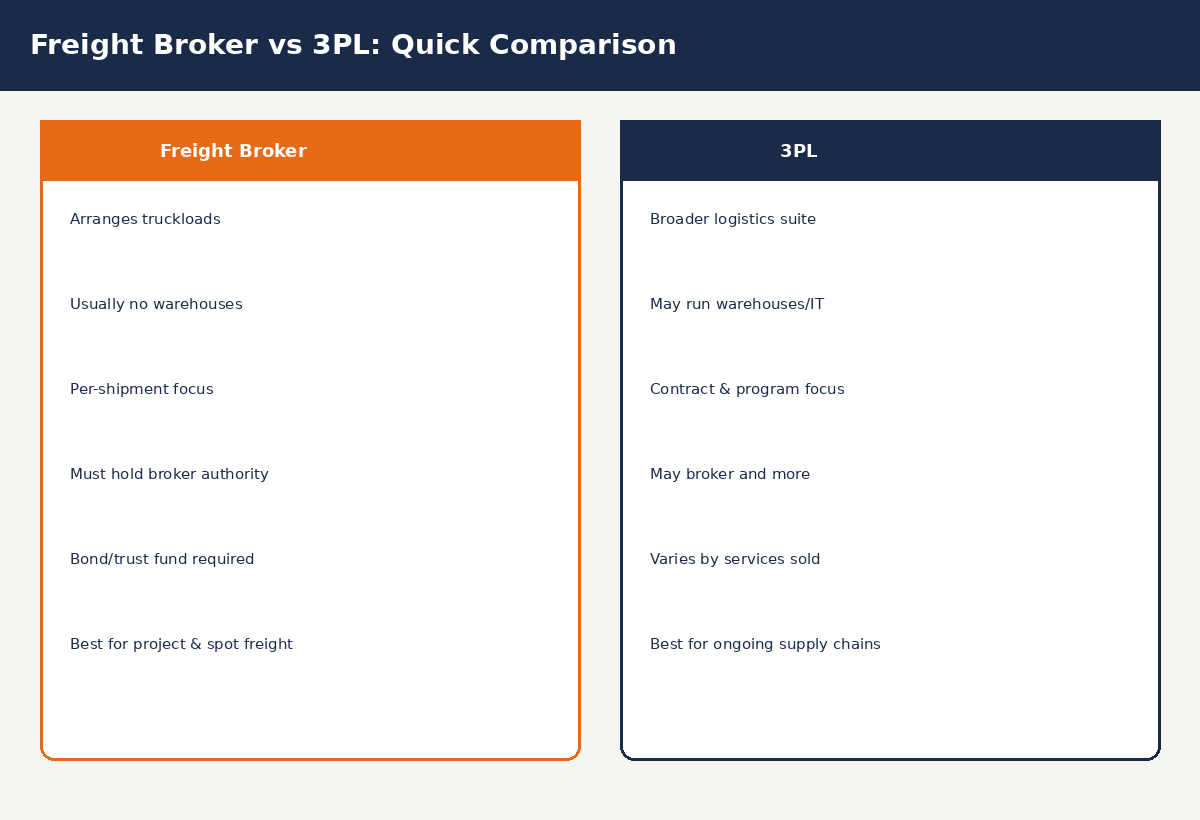
| Dimension | Freight broker | 3PL |
|---|---|---|
| Scope | Arrange transportation for loads or lanes | Often warehousing, fulfillment, tech, and transportation |
| Contract | Often per load, lane, or short master agreement | Often multi-service contract logistics agreements |
| Cost model | Shipment or lane pricing with accessorials | Program pricing that may bundle storage, labor, and freight |
| Control | Shipper keeps inventory and most process control | More process ownership shifts to the provider |
| Technology | TMS and tracking for booked moves | WMS, OMS, and visibility suites are common |
| Ideal fit | Project freight, spot capacity, specialized equipment | Ongoing fulfillment and multi-node supply chains |
Reading the table as a 3PL vs broker vs carrier triangle helps too. Carriers operate trucks; brokers arrange carriers; many 3PLs manage a wider stack and may subcontract either role. Print the matrix beside your freight broker vs 3pl scorecard so stakeholders argue from the same sheet.
Where They Overlap
Overlap is real. Many 3PLs hold broker authority and book truckloads as one line of service. Some freight brokerage firms add light managed-transportation tools that feel like a thin 3PL layer.
Both models sell access to capacity, both care about on-time pickup, and both should verify insurance and authority on the trucks that move your freight. The label alone does not tell you who owns the warehouse or who signed the rate confirmation.
Ask for the legal entity on each document. A clean paper trail matters more than a marketing category when a claim or detention dispute appears. When the broker path is the right one, how to choose the right freight broker covers the next checks.
When to Choose a Freight Broker
Choose a broker when your main need is transportation: construction equipment, vehicles, industrial pieces, seasonal surge truckload, or irregular project freight. You want vetted capacity without handing over warehouse operations.
A freight broker vs. 3PL decision often lands on the broker when specialized trailers, permits, or one-off sites matter more than a long fulfillment contract. Spot and project lanes reward speed and equipment fit.
If your day-to-day need is truckload services rather than inventory management, start with brokerage and keep warehouse decisions separate.
Brokers also fit shippers who already have strong internal logistics staff and only need help covering hard lanes. You keep the playbook; the broker finds the truck.
When to Choose a 3PL
Choose a 3PL when inventory sits in storage, orders ship daily, and you want one partner to own more of the operational stack. E-commerce brands, omnichannel retailers, and manufacturers with regional distribution nodes often land here.
Businesses considering a broader outsourcing model can learn more about its advantages in this guide to third-party logistics benefits.
If labor, racking, returns, and carrier management are pulling focus from your core product, contract logistics with a 3PL can consolidate vendors. Price the full program, not only the freight line.
When fulfillment SLAs, SKU complexity, and returns volume dominate the conversation, the freight broker vs. 3PL question usually resolves toward the 3PL.
Can You Use Both?
Yes. Many shippers keep a 3PL for warehouse and daily parcel or LTL flow, then use a freight broker for oversize equipment, project truckload, or surge lanes the 3PL does not cover well.
Hybrid models work when roles are written down. Name who books which mode, who owns claims on each move, and how rates are approved so procurement and operations do not fight over the same shipment. A written split keeps the freight broker vs. 3PL debate from restarting on every PO.
Using both does not excuse weak vetting. Every truck that shows up still needs authority and insurance checks, whether the booking came through brokerage or a 3PL transportation desk.
Questions to Ask Before You Sign
- Which legal entity holds broker or carrier authority on my freight?
- What services are included, and what is billed as an accessorial?
- Who pulls permits and arranges escorts on oversize moves?
- How are claims filed, and what are cargo limits on the actual hauler?
- What technology will I see for tracking, inventory, or invoices?
- Can you share references on freight that looks like mine?
Write the answers into the agreement or rate confirmation. Ambiguity on scope is how a cheap linehaul turns into an expensive program mismatch. Bring those answers to any freight broker vs. 3PL meeting, so both options face the same questions.
If you are still unsure after those answers, bring your freight profile to our team through the contact page. We will tell you whether a broker solution covers the need or whether a 3PL-style program is the better path.
Frequently Asked Questions
Is a freight broker the same as a 3PL?
No. A broker focuses on arranging transportation between shippers and carriers. A 3PL often bundles warehousing, fulfillment, technology, and transportation into a wider outsourced program.
Which is cheaper, a broker or a 3PL?
It depends on your workflow. Brokers often look cheaper on single shipments or project lanes. 3PLs can look cheaper when storage, labor, technology, and freight are priced as one program instead of separate vendors.
Does a broker take possession of freight?
Generally no. The motor carrier takes possession when it loads the trailer. The broker arranges the move and coordinates details without acting as the hauling carrier.
Do freight brokers need a license?
In the United States, property brokers need FMCSA broker authority and must maintain a $75,000 surety bond or trust fund under 49 CFR 387.307. Always confirm active authority before you book.
Can a small business use a 3PL?
Yes. Many small brands use a 3PL for warehousing and fulfillment once order volume outgrows a spare room or a single local warehouse. Match contract length and minimums to your real volume so the program stays affordable.
Match the Model to the Work
Brokers arrange trucks. Many 3PLs run broader logistics programs. Match the work to the model, verify authority and insurance, and keep documents clear.
When you want help sorting freight broker vs. 3PL for your lanes, our team at Freight City Logistics will walk through the fit with you.