

How does freight shipping work when you need more than a parcel label? In short, you define the freight, choose a mode, get a quote, book the load, hand freight to a carrier at pickup, track it in transit, confirm delivery, and close out the invoice or claim.
Key takeaways:
- Freight moves under commercial documents, appointments, and carrier rules that parcel shipping rarely uses.
- Mode choice (LTL, full truckload, or specialized) drives cost, transit, and handling.
- Accurate weight, dimensions, and classification prevent expensive corrections later.
- Shipping papers and delivery signatures are your primary paper trail.
- We are licensed and bonded (DOT 3752961, MC 1332997) and coordinate freight through our partner carrier network.
Freight Shipping in 60 Seconds
How does freight shipping work at a high level? You tender freight to a carrier or broker, the carrier picks it up by appointment or dock schedule, moves it under hours-of-service and route rules, and delivers it to the consignee, who signs for delivery. Money, liability, and exceptions follow the contract and the shipping paperwork.
If you are new to commercial moves, start with freight shipping basics: what you are shipping, where it goes, when it must arrive, and whether it shares a trailer or needs the whole truck. Those four answers shape every later step.
National freight flows on highways, rail, water, and air. FHWA Freight Management and Operations describes the U.S. freight system as an interconnected network of almost seven million miles of highways, local roads, railways, navigable waterways, and pipelines. For most mid-size shippers asking how freight moves on the road network, the everyday answer is highway trucking.
The Freight Shipping Process, Step by Step
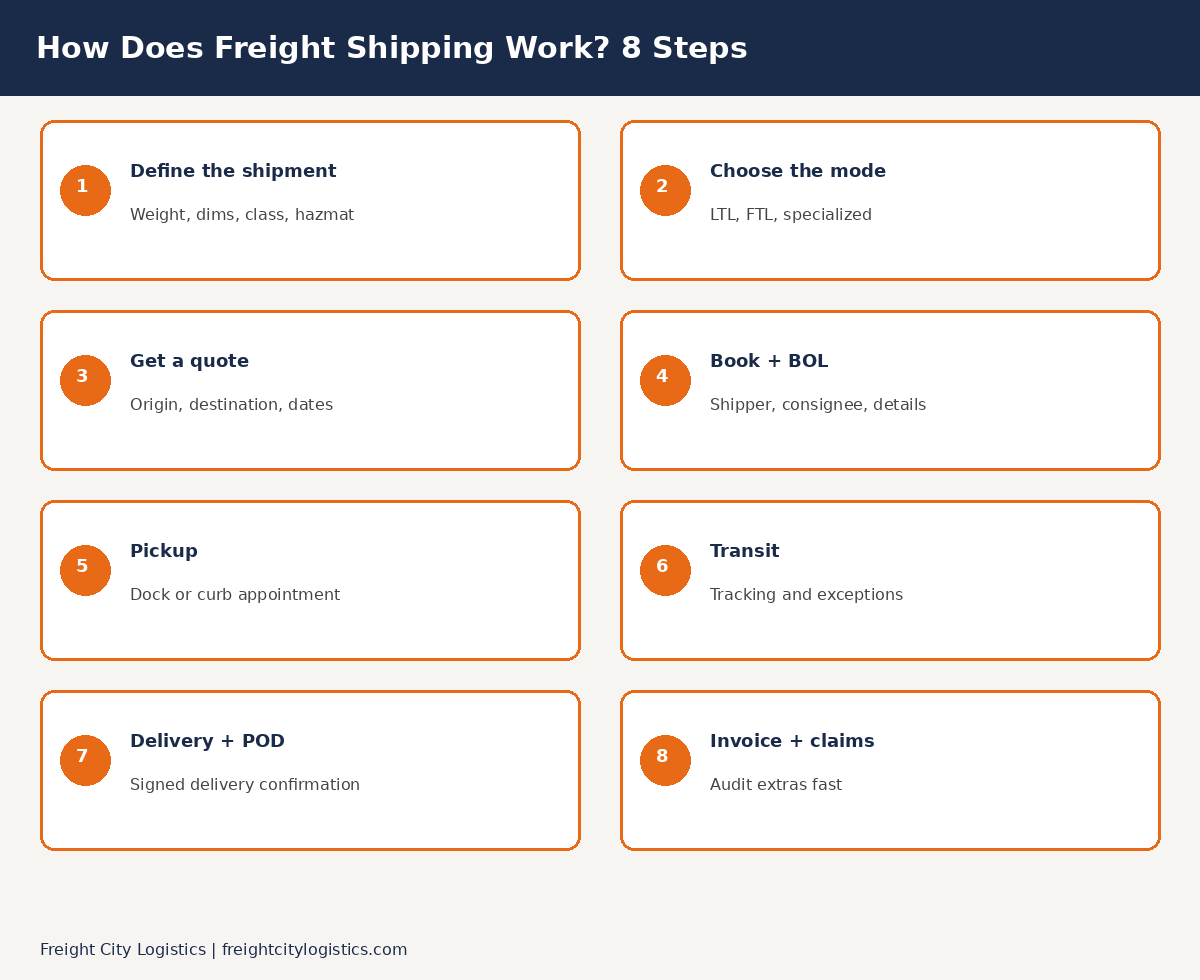
How freight shipping works step by step becomes clear once you are ready to tender a load. Use the sequence below as a practical checklist. Each step builds on accurate shipment data so the freight shipping process stays predictable from dock to door.
1. Define the shipment
List pieces, handling units, weight, dimensions, stackability, and whether the freight is new, used, crated, or hazmat. Note pickup and delivery site constraints such as dock height, forklift availability, residential streets, or limited hours.
2. Choose the mode
Less-than-truckload (LTL) shares trailer space with other shippers. Full truckload gives you exclusive use of the trailer. Specialized modes cover oversized, heavy, or temperature-controlled freight. Compare LTL vs FTL when volume sits near the break-even point.
How LTL shipping works day to day includes terminal handoffs and longer calendar time than a direct truckload run. Truckload can be faster door-to-door when you fill the trailer or need sealed, exclusive transit.
3. Get a quote
A freight quote needs origin and destination ZIPs or cities, pickup date window, mode, weight, dimensions or class, extras, and any appointment requirements. Incomplete requests produce soft numbers that change after booking.
Ask what the quote includes: fuel surcharge, liftgate, residential, limited access, or inside delivery. How does freight shipping work on price after booking? Extra services and reweighs can still adjust the final invoice if the tender was incomplete.
4. Book and prepare the bill of lading
Booking locks capacity and creates the tender. Your BOL, the shipping document the driver carries, names the shipper, consignee, piece count, weight, description, and special instructions. The consignee signs against those details.
Keep product descriptions accurate and consistent with the quote. Vague “misc freight” language invites reclass. Shipping freight for the first time goes smoother when one person owns document accuracy before the truck arrives.
5. Pickup
Confirm the appointment, dock door, or curb location. Have freight staged, labeled, and ready. Count pieces with the driver and note exceptions on the paperwork before the truck leaves.
If your dock cannot load a 53-foot trailer for truckload services, say so early. How does freight shipping work at constrained sites? Often with a smaller truck, a liftgate, or a nearby transfer, each of which should be quoted up front.
6. Transit and tracking
During transit, carriers update status through EDI, portals, or dispatcher check calls. Exception codes cover weather, appointment changes, and freight held for further instructions. Watch for proactive alerts rather than silence.
For a broader view of who coordinates these moves, see what a logistics company does. Tracking quality is part of that coordination role.
7. Delivery and proof of delivery
The consignee inspects for visible damage and shortage, then signs for delivery. Note exceptions clearly on the paperwork. A clean signature without notes makes later claims harder to support.
Appointments matter for warehouses and construction sites alike. How does freight shipping work when the consignee is closed? Freight may roll to the next day with storage or redelivery fees unless you reschedule quickly.
8. Invoicing and claims
Audit the invoice against the quoted linehaul and the actual services performed. File claims promptly with photos, shipping papers, the delivery receipt, and product value documents. Deadlines are short, so do not wait for month-end accounting alone.
Extra service fees should map to services you approved. Dispute unclear line items with documentation while the load details are still fresh.
How Freight Rates Are Calculated
Freight rates blend weight, density or freight class, distance, mode, fuel, and accessorial charges. LTL often prices from class and weight; truckload often prices per mile or per load for a lane. Market capacity can move rates week to week.
Dense, well-palletized freight usually costs less per pound than light, high-cube freight when you ship LTL. Exclusive truckload can win when cube fills the trailer even if weight is modest. Our LTL shipping services and truckload teams price both patterns regularly.
How does freight shipping work for budgeting? Build a lane history, track how often extras appear, and rebid when volume grows. A single online calculator rarely captures your dock realities.
When freight class is assigned correctly up front, you avoid painful corrections after the carrier reweighs or remeasures the shipment.
Key Freight Terms Glossary
| Term | Plain meaning |
|---|---|
| BOL | Contract and receipt for the shipment |
| NMFC class | Density-based grouping that helps price LTL |
| Accessorials | Extra fees beyond linehaul (liftgate, residential, etc.) |
| POD | Signed confirmation of delivery condition |
| LTL | Less-than-truckload shared trailer space |
| FTL / TL | Full truckload exclusive trailer use |
| PRO number | Carrier tracking ID for the shipment |
| Detention | Extra time charges when loading or unloading runs long |
| Reweigh/reclass | Carrier correction when tender data was wrong |
| Consignee | The party receiving the freight |
Keep this glossary nearby when you read quotes. Shared language reduces back-and-forth and keeps the answer consistent across different carriers’ portals.
Common Mistakes First-Time Shippers Make
Understating dimensions, skipping site constraints, and treating the cheapest quote as final are the most common mistakes when shipping freight for the first time. Another frequent miss is leaving personal or high-value items unmarked inside crates.
Also avoid booking without a clear contact at delivery. How does freight shipping work when nobody answers at the consignee? The driver may wait, burn detention, or roll away, and you still pay for the attempt.
Finally, do not ignore packaging. Damaged cartons without notes on the delivery paperwork weaken claims. Solid freight shipping basics include packaging that survives terminal handling on LTL lanes.
Start Your Shipment
Ready to tender your next load with clear documents and a realistic mode choice? Come to us to request a freight quote, and we will walk through weight, dimensions, timing, and extras so the booking matches the dock.
With us, the eight steps above run through four stages: request a free quote, confirm booking, schedule pickup, and track and receive your shipment.
Whether you are filling a first pallet or a weekly truckload program, we coordinate through vetted partner carriers and keep communication tied to the paperwork you signed. That is how freight shipping works when you want fewer surprises.
Frequently Asked Questions
How does freight shipping work for a small business?
Small businesses usually start with LTL for partial loads and move to truckload when volume fills a trailer. You still need accurate dimensions, complete shipping paperwork, and a delivery contact. A broker or carrier sales contact can quote several modes, so you do not need your own trucks.
What is the difference between freight and parcel?
Parcel covers small packages under common carrier parcel networks with label-based tracking. Freight covers larger, heavier, or palletized shipments that move under commercial shipping documents, appointments, and often different liability rules. Freight also uses classification and dock equipment more often than parcel.
What documents do I need to ship freight?
At minimum, you need a completed bill of lading and any required packing lists, appointment confirmations, or hazmat forms. After delivery, keep the proof of delivery and the invoice. Some receivers also require advance shipping notices before the truck arrives, so ask the consignee early.
How are freight rates calculated?
Rates reflect mode, distance, weight, density or class, fuel, capacity, and extra services. LTL emphasizes class and weight; truckload often prices the whole trailer for a lane. Incomplete shipment data produces quotes that change after pickup, so send accurate dimensions and any extra-service needs with every request.
How long does freight shipping take?
Transit time depends on mode, distance, appointments, and weather. Direct truckload can be faster than multi-terminal LTL on the same lane. Your quote should separate pickup timing from driving days so you can plan with the consignee and set a realistic delivery appointment.
Turn the Process Into a Repeatable Playbook
How does freight shipping work from tender to delivery confirmation? Once you know, each shipment gets faster to book and easier to audit.
When you want a partner that treats the process as a playbook rather than a one-off scramble, our team at Freight City Logistics will run it with you.